


Version 1.0
1. Introduction
To line with the Laboratory and Research Safety Policy, the Safety, Health and Environment (SHE) Office of HKSTP endeavors to promoting and maintaining a safe and healthy working environment in the laboratories at Science Park where cutting edge technologies and researches are employed. SHE Office conducts regular inspections to identify hazards, recommend remedial measures as well as safeguard personnel working in the laboratories. Self-inspection is also required to be conducted periodically by individual laboratories.
2. Scope and Applicability
This laboratory safety inspection program applies to all laboratories at Science Park, either operated by HKSTP or clients. It also applies to laboratory which may be operated by more than one client. In this situation, individual clients shall be responsible for overseeing the safety of their own laboratory facilities and working areas.
3. Responsibilities
Persons In-Charge of individual laboratories shall be responsible for taking care of the health and safety of their laboratories. They should cooperate with SHE Office in the arrangement of regular laboratory safety inspection. Persons In-Charge or their delegates should participate in the inspections and communicate closely with SHE Office in following up the remedial actions afterwards.
4. Laboratory Self-Inspection
As the duty of managing laboratory safety rests with individual clients, Persons In- Charge or their delegates shall conduct periodic safety inspection at their laboratory areas using the Laboratory Self-Inspection Checklist provided by HKSTP. Completed checklists with records of following up actions shall be kept for at least one year for future checking during the inspection or audit arranged by SHE Office of HKSTP.
5.Frequency of Inspection
The required frequency of inspection arranged by SHE Office and self-inspection to be conducted by individual clients are delineated in the following table:
| Frequency of Inspection (per year) | |||
| Category 1 Lab | Category 2 Lab | Category 3 Lab | |
| Inspection by SHE Office | ≥ 1 | ≥ 1 | ≥ 2 |
| Self-inspection | ≥ 1 | ≥ 2 | ≥ 2 |
The frequency depends on risk category of individual laboratories. Category 1, 2 and 3 represent laboratories of low, medium and high risk levels respectively*. The inspection arranged by SHE Office is at least once every year for low to medium risk laboratories; and twice for high risk laboratories. As for self-inspection to be conducted by individual clients, the frequency is at least once every year for low risk laboratories and twice for medium to high risk laboratories. These frequencies will be subject to change depending on the associated risk level and safety performance of individual laboratories.
* Note: please refer to Annex 1 for details about the categorization of laboratories
6. Inspection Report and Remedial Actions
After each inspection conducted by SHE Office, an inspection report will be issued to the corresponding Person In-Charge within 14 working days. Each identified laboratory safety issue will be rated as I, II or III according to the action levels. Required remedial actions shall be completed within the time period prescribed for each action level as described in the table below. The report, with the remedial actions recorded, shall be returned to SHE Office for information and following up actions or verification if necessary.
| Action Level | Required Remedial Action and Time Line |
| I | Recommended good practice / required maintenance work to follow the planned schedule |
| II | Remedial action required within 4 weeks |
| III | Immediate remedial action required |
The concerned Person In-Charge shall also return the report with records of completed remedial actions to SHE Office within the prescribed period for reference and following up whenever necessary.
7. Overall Laboratory Safety Performance
According to the findings from the inspection, the overall laboratory safety performance of the corresponding client will be stated in the report issued by SHE Office. This would be either “good”, “fair” or “unsatisfactory” subject to the number of safety issues and their action levels.
As the inspection report associated with unsatisfactory performance reveals a great number of laboratory safety issues or issues of imminent dangers to laboratory personnel, Director of SHE has the right to issue a suspension notice to the concerned client. Laboratory operation shall not be resumed until remedial action has been followed through to the satisfaction of the Director of SHE. HKSTP also has the right to terminate the tenancy for a client’s laboratory space in case the client violates local legislation or breaches the leasing requirements with respect to laboratory safety.
Annex 1 - Risk Categorization of Laboratories at the Science Park
Laboratories at the Science Park are currently classified into three risk categories, i.e. Category 1 (Low Risk), Category 2 (Medium Risk) and Category 3 (High Risk). The criteria for classification is based on a simple 3x3 risk heat map as described below.
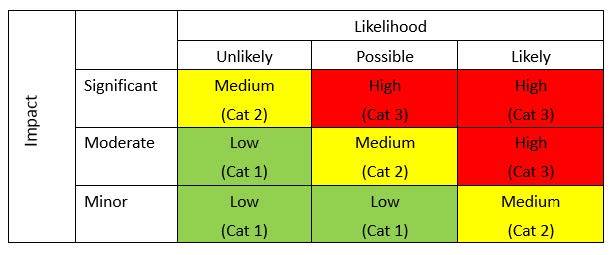
The factors associated with “Impact” and “Likelihood” in the risk heat map for laboratory categorization are described in the following table.
| Impact | Likelihood | ||
| Minor: |
|
Unlikely: |
|
| Moderate: |
in the lab
|
Possible: |
measures are in place but not
|
| Significant: |
kept in the lab
|
Likely: |
with respect to lab safety has been recorded
|