Safety, Health, and Environment (SHE) Handbook
Version 1.0
<< Previous
Next >>
Part II Laboratory and Research Safety Requirements
Section A Policy
A01 Laboratory And Research Safety Policy
1. Preamble
Hong Kong Science and Technology Parks Corporation is committed to the health and safety of everyone involved in or affected by laboratories and research activities on its premises by:
-
Complying with all applicable local statutory safety, health, and environmental regulations;
-
Adopting applicable international standards and best practices in laboratory and research safety;
-
Building a standard laboratory environment with well-maintained infrastructures and facilities;
-
Promoting a culture of safety among the research communities in the Science Park.
2. Purpose
This Laboratory and Research Safety Policy provides a safety management framework for controlling the environmental, health and safety risks arising from laboratory and research activities with hazardous chemicals, biological agents and physical agents. It provides the foundation for the development of guidelines and procedures for various indispensable laboratory and research safety programs.
3. Scope
In this policy, the governance and responsibilities for managing health and safety in laboratories are defined. Laboratory and research safety requirements are applicable to all corporate management units, Clients and visitors.
4. Definitions
Building Provisions: Refers to building services and utilities in accordance with the building plan, which include the MVAC system with preinstalled duct works, electrical services, fire Installation services, building drains, plumbing and town gas, etc.
Clients: These include tenants, incubatees and any affiliated laboratory users including licensees, registered members, etc.
Corporation: Refers to Hong Kong Science and Technology Parks (HKSTP) Corporation (also referred to as “HKSTP”).
Laboratory: A laboratory is a space, building or part of a building which is specially designed and built for conducting scientific research, experiments, tests and related works with potential hazards.
Laboratory Provisions: Laboratory services and utilities that are fitted out in later stage to provide certain utility services for laboratory operation, such as compressed air, nitrogen, carbon dioxide, pure water, chemical drain with neutralization plant and fume exhaust system.
Laboratory Person In-Charge: A competent person delegated to manage the health and safety issues of an individual laboratory.
Laboratory Worker/User: A laboratory worker or user is any person (including employee, student, or visitor) who works in a laboratory with or without pay.
Management Units: Refer to divisions and departments of HKSTP Corporation (A list of concerned management units is shown in Annex 1).
Risk: Means, in relation to any potential injury or harm, a measure of the likelihood and consequence of injury or harm occurring.
Science Park: Refers to the location where the Corporation’s premises are situated.
5. Governance and Responsibilities
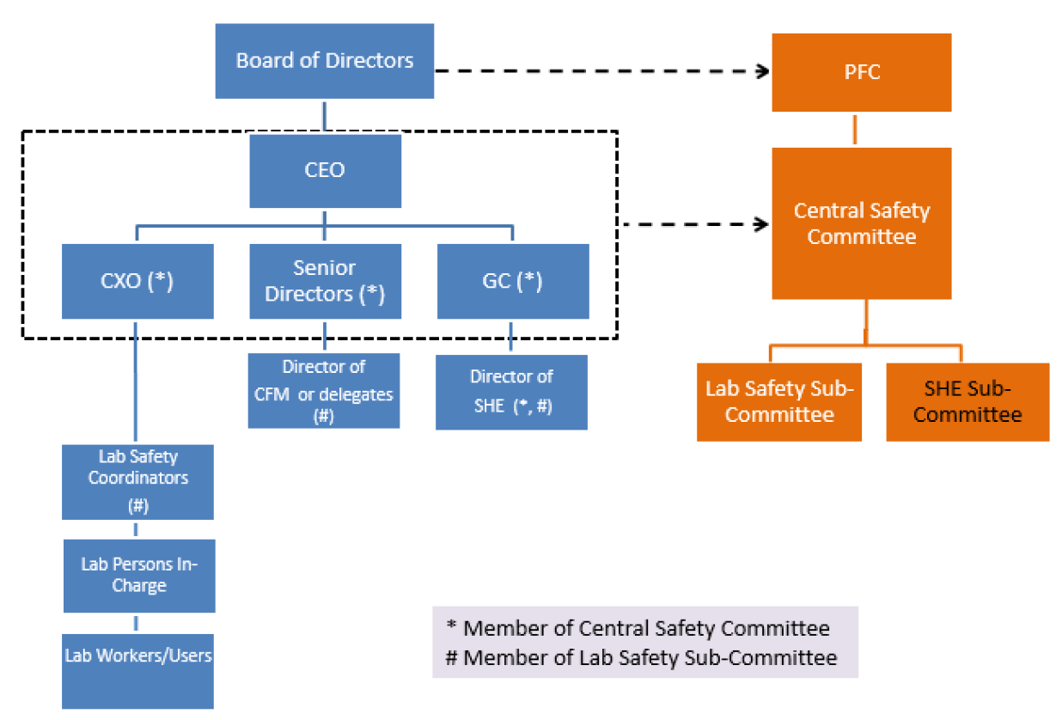
A diagrammatic representation of the governance model is attached in Annex 2.
5.1 The Board of Directors
- Establishing the Corporation’s health, safety and environmental policies, standards and procedures through the Project and Facilities Committee (PFC). Overseeing their implementation through the Chief Executive Officer (CEO) in the Central Safety Working Group.
5.2 The Chief Executive Officer (CEO)
-
Having the overall responsibilities for health, safety and environmental matters within the Corporation. Leading the Central Safety Working Group, as its Chairman, in the implementation of the corporate health, safety and environmental policies, standards and procedures established by the Board of Directors. Managing to provide adequate resources on health, safety and environmental programs at all levels.
5.3 The Central Safety Committee
The Central Safety Committee serves as an executive team of the Corporation reporting directly to PFC for overseeing and implementation of the corporate health, safety and environmental policies, standards and procedures. Its responsibilities include:
-
Formulating policies, standards and procedures for adoption by the Corporation.
-
Implementing and monitoring of the adopted policies, standards and procedures.
-
Monitoring and review of the overall health, safety and environmental performance and compliance with applicable government regulations and relevant standards.
-
Establishing Sub-committees or special advisory groups, as appropriate to deliver advice and guidance on special policies and to monitor risk control in affected areas.
-
Developing effective communications channels with different management units.
-
Having regular discussions at least twice a year.
5.4 The Laboratory Safety (LS) Sub-Committee
The LS Sub-Committee is a special advisory group and is responsible to the Central Safety Committee for overseeing and implementation of laboratory safety related policies, standards and procedures. Its responsibilities include:
-
Formulating laboratory related health and safety policies, requirements and guidelines.
-
Developing mechanism for a coordinated and consistent approach to managing laboratory safety risks across the Corporation.
-
Setting laboratory related health and safety performance targets for the Corporation.
-
Monitoring laboratory and research safety performance in compliance with relevant legislations, policies, standards and procedures.
-
Reviewing particular laboratory related health and safety issues.
5.5 Safety, Health and Environment Office (SHE)
SHE assists the Central Safety Committee and LS Sub-Committee in execution of health, safety and environmental policies, guidelines and procedures across the Corporation. It has the following responsibilities with respect to laboratory and research safety:
-
Developing and implementing the corporate laboratory and research safety policies, guidelines and procedures.
-
Providing and maintaining the necessary laboratory facilities applicable to the Clients in safe and sound conditions.
-
Advising the management units and Clients on all aspects of laboratory and research safety including laboratory design, laboratory safety practices, and compliance with local legislation, corporate policies, and international best practices.
-
Monitoring the management of laboratory and research safety by conducting audits, inspections, etc.
-
Investigating laboratory related incidents and accidents and devising preventive measures to avoid recurrence.
-
Assessing the need for and developing training programs to promote laboratory and research safety.
-
Suspending or prohibiting any laboratory operation that poses an imminent risk of serious injury or ill health.
5.6 Community and Facilities Management (CFM)
The Director of CFM leads the Community and Facilities Management (CFM) and has the following roles with respect to laboratory and research safety:
- Liaising with the Clients, where appropriate, and vets the corresponding layout plans in respect of building regulations and building provisions requirements.
- Ascertaining if the building provisions including essential and backup power, cooling, etc. meet with the Clients’ requirements or provides alternative solutions.
- Maintaining the building provisions including central MVAC system to meet the committed level of services.
- Serving as advisor for the LS Sub-Committee.
5.7 Laboratory Safety Coordinators (for concerned Divisions or Units of HKSTP)
Management Units of the Corporation with operation of laboratories and research facilities have responsibilities to ensure health, safety and environmental compliance for their laboratory operations. Each of these Management units shall appoint appropriate number of Laboratory Safety Coordinators, preferably at senior manager grade, and ensure sufficient training and resources are provided to such appointed
person in order to perform the assigned tasks. General duties of the Laboratory Safety Coordinator include the followings:
- Serving as ex officio member of the LS Sub-Committee.
- Formulating laboratory safety management system specific to the laboratory concerned including rules and guidelines in consultation with SHE of the Corporation.
- Monitoring the implementation of applicable laboratory and research safety policies and guidelines in the respective laboratories and research facilities.
- Liaising with relevant parties on laboratory and research safety issues.
5.8 Laboratory Persons In-Charge
Laboratory Persons In-Charge are designated by individual HKSTP’s Management Units or Clients, as the case maybe (in consistent with the content of the “Health, Safety and Environment Compliance Declaration” form). They should have received relevant safety training, be familiar with the laboratory operations and safety procedures in the laboratories. The Laboratory Person In-Charge is responsible for:
- Managing on a day-to-day basis the health and safety of the laboratories or parts of the laboratories under their supervision according to the established laboratory safety policies and regulations of the Corporation and the Clients where applicable.
- Providing laboratory safety orientations to all new laboratory workers or users.
- Preparing safety instructions or standard operating procedures (SOP) for certain hazardous operations and arrange training to laboratory workers or users accordingly.
- Carrying out or delegate an appropriate person to carry out regular self-inspection of the laboratory or parts of the laboratory.
- Reporting any laboratory related incident or accident timely to the Corporation via SHE.
5.9 All Laboratory Workers / Users
- Completing laboratory safety orientations and special safety trainings as required by individual Client’s research facility/center.
- Conducting laboratory activities in a safe manner in compliance with all applicable laboratory safety rules and regulations.
- Reporting any unsafe conditions, incidents or accidents timely to their Laboratory Persons In-Charge or the emergency response team where appropriate.
6. Essential Elements of Laboratory Safety Management
6.1 Space Allocation and Laboratory Design
Laboratories having activities liable to generating contaminants or involving the use of hazardous chemicals, biological agents, radioactive substances, electrical/mechanical equipment such as high power laser system, etc. shall be assigned to a laboratory space and appropriately designed with safety features for those particular laboratory activities. In the Science Park, many aspects including the premises use classification, building provisions, laboratory provisions, etc. shall be taken into consideration to ensure that appropriate space is allocated for the intended laboratory operations. Office premises are generally not suitable to be retrofitted for laboratory operations. The following regarding requisition of laboratory space and its design shall be observed:
- All laboratory space requests shall be reviewed by CFM and SHE. Approval of the space is based on information provided by applicants including intended laboratory function, types of research activities, hazardous materials, equipment and instrument involved.
- Laboratory has to be designed to meet all applicable local statutory requirements as well as the requirements and principles stated in the HKSTP Laboratory Design Guidelines.
- Commissioning of laboratories shall be carried out by the responsible service providers and relevant testing/commissioning reports should be available for checking.
- SHE and CFM shall arrange a joint laboratory pre-occupancy safety check with the Client once the construction work is completed.
6.2 Designation of Laboratory Persons In-Charge
- To ensure the laboratories or research activities are effectively managed following the applicable laboratory safety management requirements, a Laboratory Person In- Charge shall be designated by each laboratory or research facility of the Corporation or tenants. His/her duties are described in Section 5.8.
- The name and contact details of the Laboratory Person In-Charge shall be displayed on the placard at the entrance of each laboratory for communication in case of emergency or whenever necessary.
- Changes of the Laboratory Persons In-Charge must be reported timely to the SHE of the Corporation.
6.3 Hazard Identification and Placard System
- Hazards associated with the laboratory operations shall be identified by the management of the Clients or their delegates. Alerts on these identified hazards as well as the emergency contact details for each laboratory shall be displayed at the entrance of each laboratory in the form of a placard following the Corporation’s requirement as set out in the HKSTP Laboratory Design Guidelines.
6.4 Access Control and Laboratory Security
- Laboratories shall be equipped with self-closing doors and the doors shall be locked at all times under normal situation.
- Entry to any laboratory shall be restricted to individuals who are authorized by the Laboratory Persons In-Charge. Authorization criterions shall be clearly identified, such as training needs, proper laboratory attire and etc.
- Report any entry of suspected persons or unaccounted loss of hazardous materials to ensure the security of laboratories.
6.5 Laboratory Safety Training
- Laboratory Persons In-Charge shall ensure that laboratory safety orientations are provided to all new laboratory workers before they are allowed to work in a laboratory.
- In addition, the Laboratory Persons In-Charge should identify the training needs of individual laboratory workers and arrange for specific training as soon as practicable. Especially for certain hazardous operations, standard operating procedures (SOP) should be written and training should be provided accordingly.
- All laboratory safety training records shall be kept readily available for checking during periodic laboratory safety inspections or audits.
6.6 Laboratory Safety Inspection and Audit
- SHE shall carry out laboratory safety inspection at all laboratories periodically. A report for each inspection or audit with detailed findings shall be issued to the management of the laboratory. Corrective actions shall be taken by the management and replied to SHE within the prescribed period.
- SHE shall conduct laboratory safety audits on any specific research areas or facilities where appropriate and whenever necessary.
- Each Laboratory Person In-Charge or his/her delegate shall carry out self-inspection of the whole laboratory or part of the laboratory he/she is responsible for regularly at an interval in accordance with the Corporation’s requirements. Completed self-inspection records and follow-up actions shall be kept for future audits by internal or external management bodies or authorities.
6.7 Local Laboratory Rules and Procedures
- Management of the Clients shall prepare local rules and safety procedures for their operations in the laboratories.
- Emergency procedures shall also be prepared for emergency situations such as spillage of hazardous materials, leakage of hazardous gases, fire, etc.
- Such rules and procedures are preferably displayed at conspicuous areas inside the laboratories for all laboratory workers to follow.
- Rules and procedures should be based on a risk assessment process.
6.8 Hazardous Waste Management
- Hazardous wastes, including chemical waste, clinical waste and radioactive waste, shall be properly managed following local statutory regulations.
- Laboratory users shall dispose of hazardous waste into appropriate waste containers.
- Laboratory Persons In-Charge shall ensure that waste containers are kept temporarily in the laboratories under proper conditions.
- Individual Clients that possess hazardous waste disposal licenses shall arrange collection of wastes by licensed waste collectors.
6.9 Personal Protective Equipment (PPE)
- Laboratory workers shall wear proper personal protective equipment in the course of their operations in the laboratories.
- Laboratory Persons In-Charge shall ensure that all necessary PPE is readily available to the laboratory workers and properly maintained.
6.10 Laboratory Safety Clearance and Decommissioning
- Management of the Clients shall ensure that the whole or parts of a laboratory, whichever applicable, are cleared of all hazardous materials before they vacate the laboratory or parts of the laboratory.
- For certain laboratories or parts of a laboratory which have been involved in the use of highly toxic chemicals, infectious agents or radioactive substances, management of the Clients shall exercise proper decommissioning procedures to ensure that areas are free from contamination.
6.11 Suspension of Dangerous Laboratory Operations and Termination of Tenancy
- Notice of Breach and Rectification:
Laboratories shall be operated by Clients in compliance with all applicable health, safety and environmental legislations and the Corporation’s policies and rules. In case any of such is breached, a notice or report shall be issued by Director of SHE of the Corporation to the corresponding Client for rectification immediately or within a prescribed period of time.
- Suspension of Dangerous Laboratory Operations:
- Director of SHE of the Corporation has the authority to stop any laboratory operations constituting (1) a clear and imminent danger to health and safety of the personnel inside the laboratory or in the neighboring areas; or (2) a breach of local legislation or the Corporation’s policies and rules. The decision of the Director of SHE shall be final and conclusive in this regard
- In the event of such suspension of laboratory operation, Director of SHE shall immediately notify the Chairman of Central Safety Committee of the Corporation for issuance of a suspension notice to the management of the corresponding Client.
- Laboratory operations shall not be resumed until the management of the Client has verified to the satisfaction of SHE that appropriate hazard control measures are in place or relevant local legislation or the Corporation’s policies and rules are followed through.
- Termination of Tenancy:
In case the management of the Client fails to take remedial actions to the satisfaction of SHE, the Corporation has the right to terminate the tenancy for the concerned space following procedures laid down in the tenant’s agreement of the Lease.
7. Essential Elements of Research Safety Management
Some of the most promising opportunities for research in science, technology, and medicine carry with them new hazards and significant risks. The Corporation places the highest priority on its responsibility to mitigate these risks and to protect the health and safety of lab personnel, research participants, the general public, and the environment.
7.1 Research Safety and Risk Assessment
- Risk assessment shall be conducted to anticipate any new potential health and safety hazards associated with the advanced facilities and techniques. Some research technology can be so advanced that local safety legislation framework may not have been established. In such situation, international best practice, guidelines of professional institutions and prudence principle should be applied.
- Upon completion of a risk assessment, appropriate safety control measures shall be in place in order to safeguard laboratory personnel and protect the environment. Risk assessment records should also be properly kept for audit.
- Risk assessment should be reviewed regularly or whenever necessary.
- For Clients from university or research institutions, those research projects to be conducted in the Science Park are required to be reviewed by their relevant research safety offices.
7.2 Research Ethics
Research protocol shall be reviewed by a research ethics committee in accordance with local regulatory requirements and international ethical standards governing research involving human participants and or animals before that particular part of research activities are allowed to be conducted in the Science Park.
- Any research activity involving human participants for scientific research purposes must be reviewed and approved by an institutional and/or national Human Research Ethics committee (HREC).
- All research activities involving the care and use of animals for scientific research purposes shall be subject to ethical review, approval and monitoring by an Animal Ethics Committee (AEC).
- All procedures performed in the Science Park shall be in accordance with the protocols approved by the research ethics committee.
- All research activities must cease if approval from the ethic committee is suspended or withdrawn.
Annex 1. A Diagrammatic Representation of the Governance Model
<< Previous
Next >>